
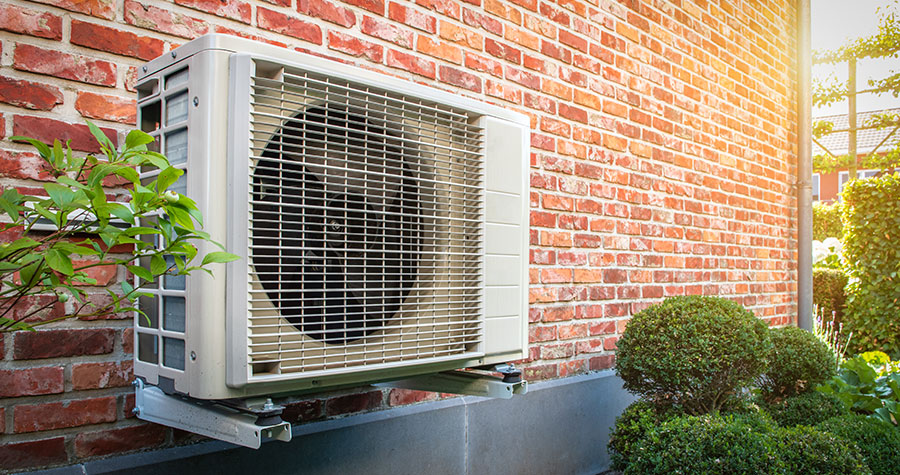
When we think of home comfort, we picture the perfect temperature… not a constant hum in the background. And yet, the noise level of heat pumps and air conditioners is a much bigger issue than most people realize.
The good news? Modern units are a far cry from the “tractors” of yesteryear.
Just how loud are they, exactly?
The noise level emitted by each unit is listed on its technical specifications. It is measured in decibels (dB) for both indoor and outdoor components and varies depending on different unit parameters (power, build quality, etc.).
To give you a concrete idea:
🌿 30 dB: a whisper, very quiet
🏠 40–50 dB: a quiet conversation
🌧 60 dB: moderate rain
👉 Most modern heat pumps operate between 40 and 60 dB outdoors, and often even less indoors. In other words: in many cases, your unit makes less noise… than your dishwasher.
The noise level produced by the unit installed outside the house is the most important factor, because if it’s too loud, it could disturb your neighbors.
Indoors vs. outdoors: two different realities
Indoors, wall-mounted units (very popular in Quebec) are generally very quiet, especially in low-speed mode. We’re often talking about 20 to 40 dB—perfect for sleeping without waking up at the slightest whisper.
Outside, the outdoor compressor is louder, but recent technologies have significantly reduced noise thanks to:
- better-designed fans
- variable-speed compressors (inverter technology)
- better sound insulation
The “variable-speed” factor
Modern heat pumps with inverter technology continuously adjust their power output.
Unlike older systems that ran at full power (and full noise), these models:
- start up smoothly
- maintain a steady speed
- avoid noisy on/off cycles
The result: a more consistent noise level… and much less disruptive.
Why are some units noisier?
Not all systems are created equal. Noise can vary depending on the unit’s quality (entry-level vs. high-end), installation (poor installation can amplify vibrations), maintenance (a dirty unit becomes noisier), and location (near a window or on a resonant surface, and there you have the drum effect).
An often-overlooked detail: a poorly installed unit can seem twice as loud… without actually being so.
Noise and regulations: what you need to know
To find out if the model you’re interested in is likely to cause a neighborhood dispute, check your municipality’s regulations regarding permitted noise levels for this type of unit.
In Quebec, some municipalities impose noise limits, especially at night. In residential areas of Montreal, for example, outdoor noise levels must be between 50 and 55 dB from 7 a.m. to 11 p.m., and between 40 and 45 dB from 11 p.m. to 7 a.m. Indoors, however, the situation is different, as the units are very quiet (between 30 and 50 dB), regardless of the manufacturer.
👉 In general:
- discreet installations are preferred
- avoid pointing the unit toward neighbors
- anti-vibration mounts are sometimes installed
A good installer thinks of all this from the start—and saves you a lot of headaches.
Today, a well-chosen and properly installed heat pump or air conditioner offers you optimal thermal comfort, quiet operation, and harmonious coexistence with… everyone.
And if your current system sounds like a plane taking off, that’s not normal—it’s probably a sign that it’s time to upgrade. We can guide you in choosing your unit and installing it. Contact us at 450-224-2941