
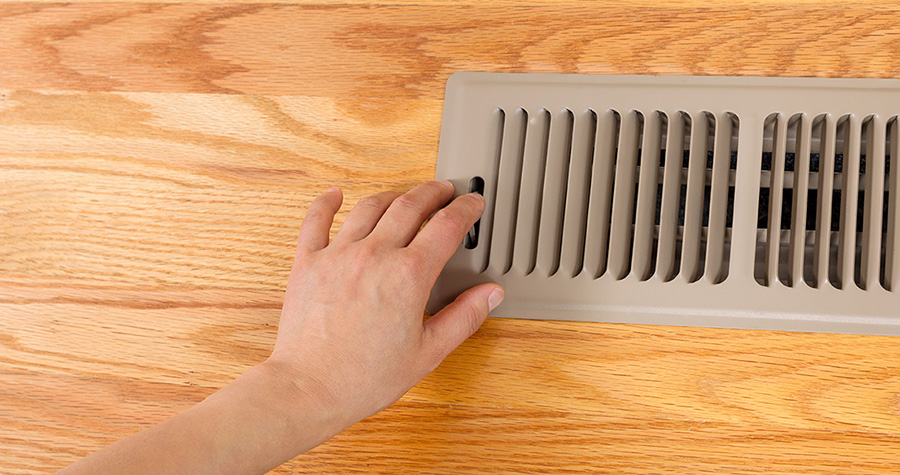
You hardly ever use the guest room, so why heat it as much as the rest of the house? Closing the heating vent may seem like a simple way to save energy. However, with a central forced-air heating system, doing so can sometimes have the opposite effect.
The idea certainly seems logical: sending less warm air into an unused room should mean using less energy. But a central heating system doesn’t quite work that way.
Your system is designed to heat the entire home
In a forced-air system, the furnace or central heat pump heats the air, and a blower then distributes it throughout the home through a network of ducts and supply vents.
This network is normally designed to maintain a certain airflow throughout the house. The size of the ducts, the number of vents and their location all contribute to proper air circulation.
When you close a vent, the air that would normally flow through it has to be redirected elsewhere in the ductwork.
Occasionally closing a vent or slightly adjusting its opening generally isn’t a problem. Issues are more likely to arise when several vents in different rooms are completely closed.
Closing vents doesn’t necessarily mean saving energy
Unlike some heating systems where each room has its own heating unit and individual control, a central system generally continues to produce and circulate heated air according to the needs detected by the thermostat.
Closing several vents therefore doesn’t automatically reduce energy consumption.
Instead, it can increase pressure inside the ductwork and alter the balance of the system. Your heating equipment may then have to operate under conditions that differ from those it was designed for.
In other words, your furnace or heat pump doesn’t think, “Great! Two fewer rooms to heat — I’ll take the afternoon off.”
Too bad, but heating systems haven’t quite reached that level of initiative yet!
A very cold room can also cool neighbouring rooms
There’s another factor we don’t always consider.
Even if a room is rarely used, it remains inside your home’s building envelope. If you allow it to become significantly colder than the rest of the house, heat from neighbouring spaces will naturally tend to move toward that colder area.
The walls, floors and ceilings separating rooms are generally not insulated in the same way as exterior walls.
As a result, you may create a temperature imbalance without achieving the energy savings you expected.
A very low temperature in certain areas can also make the home less comfortable and, depending on conditions, contribute to condensation on cold surfaces.
Why are some rooms too warm?
If you regularly close vents because one room consistently becomes too warm, the real issue may lie elsewhere.
Significant temperature differences between rooms can be caused by:
- an imbalance in air distribution;
- an improperly adjusted register;
- a blocked, poorly sized or leaking duct;
- a dirty filter restricting airflow;
- the location of the thermostat;
- sun exposure;
- the insulation or airtightness of certain rooms;
- a system whose capacity or settings no longer properly match the needs of the home.
In these situations, completely closing a vent may simply mask the problem rather than correct it.
Can you still adjust your heating vents?
Yes. That doesn’t mean every register in the house should be considered untouchable.
Minor adjustments can help improve comfort, particularly when one room receives slightly too much warm air. However, it’s best to avoid completely closing several vents in an attempt to reduce your heating bill.
If temperature differences are significant — for example, if the living room is perfectly comfortable while a bedroom remains cold even though the thermostat is set to 21°C — it may be worthwhile to have the air distribution and heating system checked.
Comfort also depends on proper air distribution
A good heating system isn’t simply about producing enough heat. That heat also needs to reach the right places efficiently.
A comfortable home depends on several factors working together: properly sized equipment, good airflow, appropriate ductwork, regular maintenance and settings suited to the home.
So before condemning the guest room to a winter in the cold, it’s better to let your system breathe!
And if some rooms in your home are consistently too warm or too cold, the problem may lie in the way air is being distributed. The Pétrole Pagé team specializes in ventilation and air distribution. We also manufacture our own ventilation ductwork, allowing us to work not only on the heating and cooling equipment itself, but also on the network that distributes air throughout your home.
Because having a good heating system is one thing. Having a system that distributes heat efficiently throughout your home is where comfort really comes into its own.